an adventure into my cookbook collection: soul-searching, doing things differently & the truths I learn along the way...

deseeding pomegranates is feminine & erotic, unless you hit them with a wooden spoon...

urm..?

Tuesday, 3 December 2013

Little orange fairy cakes


I had been planning on making orange and passion fruit cupcakes, but I realised a little too late that the seal had gone on my jar of passion fruit curd, and it had gone a bit fizzy. In a way though, I’m glad. I probably would not have set out to make plain orange fairy cakes, but actually, they were brilliant, and by sticking to one strong flavour, they really worked. I am the kind of person that always ends up over-complicating things. Always done with the best of intentions, sometimes I just can’t leave things alone, and quite often it ends up a mess. One of my intentions for the year is to keep things simple. I wish someone would say this to the contestants on Masterchef Professionals before someone else puts black olives in a dessert, or clay on a potato.

These cakes will turn out a lot better if you use a proper fairy cake/cupcake pan, as opposed to just jamming filled cupcake cases on a flat baking tray.


 Makes, annoyingly, 26 – don’t just jam all the mix into 24 cases, as they will be too full and you risk creating mushroom cloud cupcakes.

For the fairy cakes:
250g unsalted butter, softened
250g self-raising flour
225g caster sugar
4 eggs
pinch salt
zest of 1 big orange
3 tbsp orange juice
2 tbsp milk

For the orange buttercream:
250g unsalted butter, softened
200g icing sugar
2 tbsp orange juice
zest of 1 lemon

toppings:
Crushed pistachio nuts
Pieces of crystallised ginger
Dried cranberries

180c with fan, 16 minutes

Cream together the butter and sugar, and then add the flour, eggs and salt. Mix together until a thick batter forms – this could be done in a food processor. Add the orange zest and juice, mix well and then add the milk and mix again. Add a little more milk if the batter still seems too thick. It should have a 'nice dropping consistency', ie. plop nicely off the teaspoon into the cupcake case. At this point you could throw in a handful of sultanas or dried cranberries if you wanted to.

Use a teaspoon to fill your cupcake cases no more than two thirds full and bake for 15-20 minutes, until risen and golden on the top (with my oven this took 16 minutes).


 Lift the cakes out of the tray as soon as possible and let them cool on a cooling rack.

Make the buttercream by beating together the butter, icing sugar and zest, and then gradually incorporating the orange juice (make sure the butter is really soft otherwise it will go lumpy). Use a piping bag or a knife to spread the icing over the fairy cakes – you want it to be thick, but not insanely so – the cake has a lovely light texture and orange flavour, and you don't want to overpower it.

Decorate the cakes with crushed pistachios, crystallised ginger, dried cranberries, or whatever else you fancy. Once the cupcakes are iced, put them in the fridge for a few hours to harden up the icing.


Saturday, 23 November 2013

Blackberry and black pepper vinaigrette


Picking blackberries off brambles is one of the best things about the end of the summer. My family always try to pick as many as possible, and keep them in the freezer for berry treats throughout the winter.

This vinaigrette is a perfect vehicle for frozen berries. Freezing seems to sweeten them, and they are so soft once defrosted that you don’t need to cook them down at all.

This quantity makes enough for one massive salad, or a few smaller ones.

1 cup frozen blackberries (or use fresh if available)
1 tsp grain mustard
1 tsp honey (or agave nectar, or maple syrup)
1 clove garlic, crushed
2 tbsp balsamic vinegar
3 tbsp rapeseed oil
salt and lots of freshly ground black pepper

Defrost the blackberries and mash them with a fork. If they are still too lumpy you can use a hand-blender to wiz them up, but it shouldn’t be necessary. A lot of other recipes blend the dressing, giving a uniform purple sauce. I quite like keeping things a bit more rustic though – my way the colour stays darker, and the odd escaped lump of blackberry is always welcome.

Mix the blackberry mush with the mustard, honey, garlic, oil and vinegar. Taste and season with a little salt and a lot of black pepper.

I suppose you could add a bit of fresh tarragon or fresh mint to make it a bit more complex and grown-up if you wanted to.

I used this dressing on a salad of spinach, red onions, puy lentils, goats cheese and pistachios, and it was really good.

Wednesday, 20 November 2013

How to make brussel sprouts amazing


I have got to thank Alli for introducing me to this, and adding a new vegetable to my diet.

Before I was introduced to the concept of roasting brussel sprouts like this, I genuinely couldn’t see the point of them, other than wrapping them in empty Ferrero Rocher wrappers and then giving them to annoying people. I also couldn’t understand why everyone seemed to be eating them at this time of year when no-one seems to like them.

Brussel sprouts
Olive oil
Salt – preferably coarsely ground sea salt

Pre-heat the oven to 200 degrees centigrade.

Prepare the sprouts but cutting off a bit of the base and then peeling away their leaves until they look clean and a lot less manky.


Slice the sprouts in half through the base. Put them on a baking sheet or roasting dish (in a single layer), toss them with a glug of olive oil and sprinkle with salt.

Roast for 15-20 minutes giving the tray a bit of a shake halfway through. When ready they will be brown and crunchy in places, sweet, juicy and unbelievably delicious.


 Serve the sprouts as a side dish, or add them to other roasted veggies to make a warm salad.

Roasted butternut squash and brussel sprout salad with red onion, spinach and toasted pumpkin seeds

You could also fry them with lots of butter and chestnuts, which is very nice too.


Sunday, 17 November 2013

Egg stuffed tomatoes


Egg stuffed tomato – sounds so obvious as soon as you say it out loud. This is a really delicious breakfast or brunch dish, and would be perfect if you were cooking for a lot of people as it isn’t much prep and is no-where near as ‘hands-on’ as most other kinds of breakfasty eggs.

This recipe is from The Vintage Tea Party Book by Angel Adoree, which I described in Interlude number 2 – the cookbooks. This isn’t the one I describe as thigh-quiveringly sensual, but it was very good – in more of a well-behaved Sunday brunch-y kind of way. 

Ingredients

1 large beef tomato per person
1 medium egg per person
1 tsp of your choice of filling – whatever you want really, or happen to find in the fridge. It could be: cheese, crème fraîche, pesto, chill sauce, leftover ratatouille, or even a couple of anchovy fillets.
Salt and pepper.

Preheat the oven to 200 c.

Using a sharp knife (serrated is easier for tomatoes), cut a little bit of skin of the base of each tomato so that it sits flat. Then cut the top off, creating a lid that will be used for cooking. Scoop out the seeds and middle part of the tomato flesh, creating a large well. Be careful not to go through the base.

Spoon in your choice of filling (I went for pesto, plus a little cheese on top of the egg), and then crack an egg in. Season the egg with salt and pepper, and balance the tomato lid back on top. Place the stuffed tomatoes in a lightly oiled roasting dish and cook for about 20 -25 minutes, until the white is set and the yolk is warm and runny – or however you like it.


Wednesday, 6 November 2013

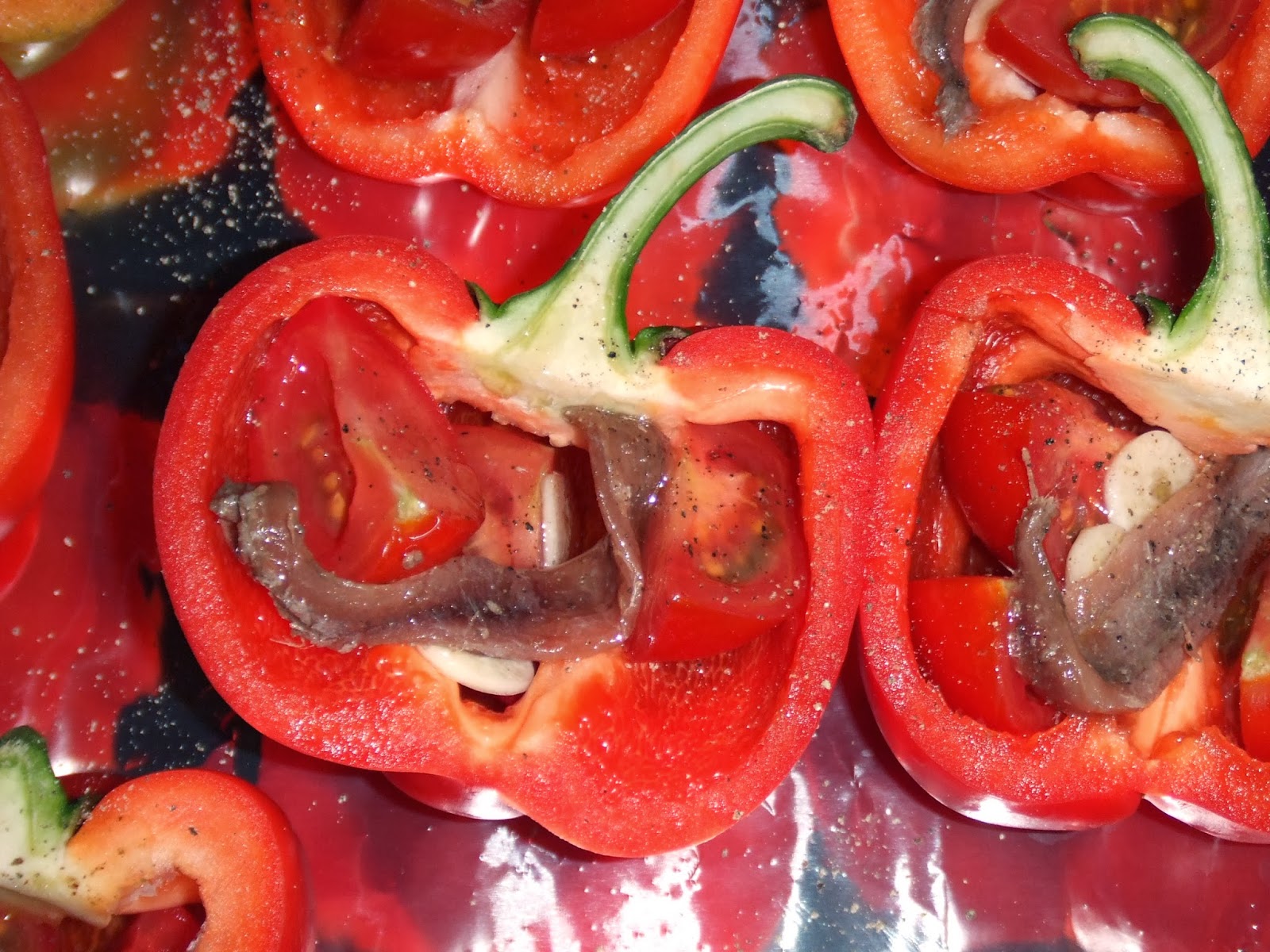
Roasted peppers with tomato, anchovy and garlic

I recently went on a kosher Italian cooking course. In Italy. With my Mum. I’m sure that most of us feel pretty accustomed to what we think of as Italian food, but really it is just scratching the surface. What astounded me so much with the food we cooked, and the food we ate over that marvellous week in Umbria, was how such massive, gutsy flavours could be brought out of a few, simple ingredients. All it took was a little olive oil and salt, and a sense of respect, time and place. And probably a little love. The course was run by Silvia Nacamulli, and I highly recommend it. For information on the Italy trip and the classes Silvia runs in London, see her website.

Making pasta at Sismano's Castle, Umbria
I learnt some great techniques and some new flavour combinations during the trip and over the coming few weeks I will be posting some recipes inspired from my time in Italy. This roasted pepper recipe was in my repertoire already (via Delia Smith and my Mum), but it certainly fits of the theme of the trip – simple ingredients, olive oil and salt, and big flavours. Make these for a starter, light meal with salad and crusty bread, or as part of an antipasti, and the flavours will knock your socks off.

Serve approx 1 pepper per person as a starter, scale up as needed. Don’t worry about making too much, they will definitely all get eaten.


Ingredients:

Red peppers (My Mum uses the pointy peppers, and while they are definitely a bit sweeter, they don’t hold the other ingredients quite as snugly, which I think really helps with the cooking.)
Smallish tomatoes - not as small as cherry tomatoes, I use medium sized vine tomatoes. Approx 1 and a half per pepper
Sliced garlic – approx 2 slices per pepper half
Anchovies (the kind that come in tins or jars) 1 per pepper half
Olive oil
Freshly ground black pepper

Preheat the oven to 180 C

Cut the peppers in half, through the stalk if possible (it looks prettier).


Carefully remove all seeds and white pithy bits, and arrange the pepper halves on an oven tray. Quarter the tomatoes and put two or three tomatoes into the middle of each pepper half. Add a couple of slices of garlic to the pepper halves, and one anchovy fillet. Pour approx half a teaspoon of olive oil into the centre of each pepper, and drizzle a little more over the tops (this is considerably less oil than in the original recipe).

Season with peppers with pepper (there is enough salt in the anchovy) and put them in the oven for about 45 minutes. It will smell amazing when they are ready, and the peppers will be soft and sweet, and a little blackened around the edges.


Enjoy!!


Sunday, 20 October 2013

Renghan Reveya: Aubergines stuffed with a peanut masala


In my previous post I mentioned my new Indian vegetarian (Gujarati) cookbook Prashad by Kaushy Patel, and this is my first attempt at one of its recipes. This aubergine dish is one of my favourite curries, and I have always been interested in learning how to make it. When I saw the beautiful stripy aubergines at Queens Park Farmers’ Market, I knew it had to be done. Of course once it is cooked you can’t tell that the aubergines ever looked like anything other than normal aubergines, but I just can’t help myself when it comes to buying interestingly coloured produce (I also bought a purple kohlrabi).

I didn’t have quite the right ingredients to make the exact recipe, so here is my attempt. Apologies for the lack of post-cooking photo, it was so unbelievably delicious that I got distracted. Seriously, it was just as good as the versions I have had in Indian restaurants, and I highly recommend it.

I had previously seen other versions of this curry that used desiccated coconut, so I thought that coconut oil would make a nice change instead of using regular oil. I have also reduced the amount of oil and sugar. The original recipe was onion and garlic free, using ¼ tsp asafoetida instead, but seeing as I didn’t have any, I thought I would use onion and garlic, especially as I didn’t have enough aubergines.

Serves 4 as part of a bigger meal with other dishes, or 2 hungry people with a little leftover if just served with rice and/or bread (I prefer chapattis to naan bread).

Ingredients:

150g peanuts, roughly chopped (you are supposed to use unroasted red-skinned peanuts, but I couldn’t get hold of any so I used roasted, salted ones. Apparently Sainsburys are having some sort of nut crisis).
15g Demerara/soft brown sugar or flaked jaggery
2 tbsp coriander seeds (or 3 tbsp ground coriander)
2 tsp turmeric
1 ¼ tsp salt (use less if you are using salted peanuts)
1 heaped tsp cumin seeds
½ can chopped tomatoes
4cm root ginger, peeled and roughly chopped
2 cloves garlic, squashed with the flat edge of a knife and roughly chopped
2-3 tsp mild chilli powder, or 1-2 tsp hot chilli powder
2 handfuls fresh coriander, chopped
100ml coconut oil (In the winter the oil with be solid, and I have found the best way to melt it so that you can measure it without wasting any, is to submerge the whole jar in a bowl of hot water for a few minutes)
Little aubergines – the original recipe called for 16 baby aubergines (aw babies), but I only had 5 slightly bigger ones. This wasn’t enough, so I would suggest using 16 babies if you can get them, or 8 teenagers.
1 medium sized onion – cut in half and sliced

Method:

Put the peanuts and coriander seeds in a mortar and pestle and grind until it is all broken down and resembles a coarse powder/crumbs (I use a really heavy stone one, and I definitely recommend getting one). 

Put the crumbs into a large bowl with the sugar, turmeric, salt, cumin seeds and tomato, mix together and leave to rest for a few minutes.

Crush the ginger and garlic in the mortar and pestle, and add it to the peanut spice mixture along with the chilli powder, chopped coriander and coconut oil. Stir it all up.

If you are using onions, heat oil in a large saucepan and put them on to fry on a medium-ish heat at this point. Stir from time to time, but allow them to colour.

Using a very sharp knife, carefully cut the aubergines into quarters lengthways, leaving a couple of centimetres at the stem so that they stay together. Gently open them out and use a teaspoon to fill them with the spice mixture, coating all four wedges of each aubergine, being careful not to split the aubergines apart. This is a really messy job, and the spice mixture will go everywhere, so it is probably best to hold the aubergines over the bowl of marinade.

Arrange the filled aubergines in the pan on top of the onions, and cover with any remaining spicy marinade – there should be a fair amount. Cover the pan and cook over a low heat for 5 minutes, and then add in 350ml boiling water – carefully around the edges so that it doesn’t wash the spice mixture out of the aubergines. Put the lid back on the pan and bring to the boil, reduce the heat and let the whole thing simmer for 25-30 minutes, until the aubergines are tender. If you are using slightly bigger ones, check the pot a few times to gently turn the aubergines.

If like me, you don’t have quite enough aubergines and a bit too much liquid, throw a handful of rice into the pot for the last 10 minutes of cooking time. The rice will cook in the delicious curry sauce, and absorb the excess liquid.

Kaushy Patel suggests that you let the dish rest off the heat for 20 minutes after it is done cooking, and then reheat before serving – to let the flavours infuse even more. I tried, but after about 5 minutes off the heat it smelt too good so I ate it straight away.


Tuesday, 8 October 2013

Interlude number 3 - Some more cookbooks


Its my 100th post!!

Probably for the last ten posts on this blog I have been counting, from 90 right until now, my 100th blog post. And of course people kept asking what I will do when I reach 100, how will I mark that momentous occasion? And here it is. No fanfare, no fireworks, just me talking about food. I suppose it is a fantastic achievement, but nothing really has changed. I’m still the same person, buying too many cookbooks and not actually cooking as much as I should be. Don’t worry though – I’m not going to get all reflective on you, I did enough of that a few posts back after Jewish New Year.

I really do buy too many cookbooks, and so it is probably time for another cookbook interlude, where I can tell you about a few of my exciting new purchases.

All of my favourite cookbooks seem to have a playing card in them, but I’m not going to tell you why.

Bake a Boo Bakery Cookbook – Zoe Berkeley

The Bake a Boo bakery is in Mill Lane in West Hampstead, and the baker/author of this book is gluten and dairy free, making this a very interesting baking book. The bakery also offers gluten and dairy-free afternoon teas. The book is full of really lovely recipes and is a really useful resource if you, like me, have a lot of friends with dietary restrictions. As well as gluten and dairy, there are also recipes that are sugar and egg free, as well as some that are full of all the things cakes are supposed to be full of, for ‘normal’ people. I am moving to West Hampstead pretty soon (woohoo) and really looking forward to visiting this bakery.

The scone recipe is sugar free and looks very similar to my Grandmother’s, which is always a good sign. Because of all the cream and jam, scones don’t actually need any sugar – apart from the odd raisin. And they will probably be the first thing that I make from this book (I am having trouble perfecting my scones). Other recipes that look really good include a pear and custard slice, Florentines, elderflower tea loaf, a vegan chocolate hazelnut cake, and a gluten-free passion fruit cake.


Prashad Indian Vegetarian Cooking– Kaushy Patel

Prashad is an Indian restaurant in Bradford, that came to prominence when it won Gordon Ramsey’s Best Restaurant TV show in 2010. It is a really lovely book – even the paper feels really nice. They are also really fantastic tweeters, an attribute I have recently come to really admire. The first time I flicked through this book, I got so excited that I did a little dance and probably squeaked quite a bit. I have many Indian cookbooks, but the reason why this one made me so happy was because it was the right kind of Indian - Gujarati. Kaushy Patel is from Surat in Northern India, the same region as the owners of the Indian restaurant of my childhood, and still probably my favourite – Rams in Kenton.  (Other favourites are Shayona and Pradips and anywhere on Drummond Street). This book contains all of the recipes of my favourite dishes, ones I have been searching for in other books for years.

A lot of recipes are vegan, wheat-free, or onion and garlic free, and so this is also a very useful book for those with dietary restrictions. The book also has a really handy selection of practical points and tips, with really excellent advice like:

‘Try not to cook when you are stressed or short on time – cooking should be a pleasure as well as a means to an end. And always think beautiful thoughts when you cook. Not only will it make you feel happier, but it will make your food taste beautiful too!’

Other handy hints in the book include tips on how how to stop aubergine from oxidising, or stop your dhal pan from foaming over.

The book has an incredible selection starters and Indian street food, including of Bataka vada – fried balls of potato with coriander, coconut and lemon, and a samosa chaat recipe which I am definitely going to try – this recipe was in fact the main reason why I bought this book. Other recipes that look really interesting include Vagareli makai, a spicy sweetcorn curry with peanuts, and Renghan reveya, whole baby aubergines stuffed with a peanut spice paste. It also contains at least three different chickpea curries, and chickpea curry is probably my all-time favourite curry (see here for a very inauthentic but still yummy one).

Supper Club – Recipes and notes from the underground Restaurant – Kerstin Rodgers

Kerstin Rogers runs a supper club called the Underground Restaurant, and blogs as Ms Marmite Lover – what’s not to love? Her book describes itself as ‘a homage to the secret restaurant phenomenon’. Despite her restaurant being really near where I live, I haven’t made it there yet, mainly due to incompatible timings and my lack of being able to get my act together. It is on my must-do list, as soon as I have some free time.

The book is so brilliant - before we even get the recipes, the section at the front deals with the practicalities of running a supper club or pop-up restaurant, with really interesting insights covering all the bases – from marketing strategies, taking payments, timings, to health and safety. There is also a great directory of all pop-ups all over the world.

As Kerstin is pescatarian, there are also more recipes in this book that I can eat than in usual cookbooks. Recipes worth mentioning include Butternut squash and feta filo triangles, Gratin dauphinoise with smoked salmon, chillies en Nogada and Chocolate and marmite cupcakes. There is also a recipe for butterscotch schnapps involving putting dime bars in a bottle of vodka, and sticking the whole thing in the dishwasher.

This comment on courgette flowers also gets a mention (for obvious reasons):

‘The flowers on the end of baby courgettes are girls. There is an almost gynaecological pleasure in teasing open the petals of the flower and inserting little goodies into it. It’s lesbian cookery!’

Skinny Weeks and Weekend Feasts – Gizzi Erskine
 
I’ve got a bit of a crush on Gizzi Erskine. Before she trained at Leiths, she was a professional body piercer, and so of course my inner teenager thinks that she is just about the coolest person ever. On the cover of this book she is looking coyly into the camera whilst showing off her incredible tattooed back, and hiding a massive knife behind her back. And there is even a little pattern of angry carrots in the background. It is definitely a book to judge by its cover. In fact, the entire book’s design and graphics are probably some of the best I have ever seen.

Skinny Weeks and Weekend Feasts is essentially a diet book – instead of the 5:2 diet, it is more of a 2:5 diet. Basically, watch what you eat during the week, and indulge on the weekends. Although I haven’t been following the diet plan exactly, I have been keeping by this philosophy for the past few months, and I think that it has, slowly, been paying off. The first half of the book contains recipes for the skinny days, and the second half of the book contains recipes for weekend feasts. To emphasize her philosophy further, only the recipes in the skinny section are calorie counted.

Recipes that I definitely want to try include:

From skinny - Black lentil soup, Low fat smoked mackerel pate and Malaysian fish stew.
From feasts - Pumpkin and cashew nut curry, Watermelon gazpacho (seriously) and Peanut butter and cornflake brownies.


Well then, there was post 100, where’s my medal?